Media Writing

Front-page newspaper article

I wrote a front-page story for Elon University’s newspaper The Pendulum. Check out my full story here: http://www.elonpendulum.com/2014/01/grade-inflation/

———————————————————————————————————————————————————————

Grade inflation: Are A’s too easy to come by? By Matt Lee

If you are one of the students who made the President’s and Dean’s Lists over Winter Break, don’t celebrate just yet.

The President’s List consisted of 718 students who received straight A’s, and 1,256 students received no grade lower than a B- in a minimum of 12 semester hours while maintaining a 3.5 GPA, landing them on the Dean’s List. Combine those numbers, and you’ll realize more than 35 percent of students are making either the President’s or Dean’s List — that’s more than one-third of the student body. According to Elon University’s student handbook, the Dean’s Lists exists to “encourage and recognize excellence in academic work.” But with so many students making high grades, is the distinction still an honor?

This isn’t the first time Elon has encountered this issue. In 2008, Elon reported a shocking statistic: more than 40 percent of the grades students received were A’s. The number of A’s had been slowly increasing over the years, but passing the 40 percent mark warranted some administrative concern.

President Lambert quickly responded in a letter titled, “Who is an ‘A’ student today?” saying, “Clearly, we must remain committed to maintaining standards of excellence.” Six years later, the percentage of A’s has only gone up.

Elon’s student handbook outlines grades as follows: an A indicates a distinguished performance, a B an above-average performance Screen Shot 2014-01-21 at 10.44.26 AMand a C an average performance. This fall, 45 percent of the grades given out were A’s, a 5 percent increase since President Lambert’s letter. Based on the handbook’s standards, those grades would indicate that almost half of Elon’s students have demonstrated a distinguished performance in class, and only 9 percent can be considered average (9 percent of grades given out were C’s). This overwhelming and increasing amount of academic success has led many students, faculty and staff to question the extent of grade inflation at Elon.

Grade inflation occurs when grades go up despite student performance not improving. The value of a letter grade decreases, and higher grades become less challenging to attain.

The problem

According to the Elon student handbook, “an Elon student’s highest purpose is Academic Citizenship: giving first attention to learning and reflection, developing intellectually, connecting knowledge and experiences and upholding Elon’s honor codes.” But is the university doing enough to challenge its students, especially now that most students are considered above-average? Sophomore Maggie Liston doesn’t think so.

Liston, a French and international studies double major minoring in political science, believes that academic rigor is lacking at Elon.

“I currently have a 4.0, and I don’t think I deserve it,” she said. “And, for me, I feel guilty, because I know that sometimes I’m not putting forth my best work, but it doesn’t influence my grades at all.”

During her first semester at Elon, Liston was shocked to discover her college courses were not as challenging as those she took in high school. She even requested outside coursework from her adviser in an attempt to push herself academically where her classes were not.

“I just had these expectations coming from high school that college would be this fountain of knowledge that I could soak up and that everyone would be as excited as I was, and it wasn’t that way,” Liston said. “So that upset me, and I definitely wondered if I was in the right place.”

Liston is not alone. Junior Delaney McHugo also sees a problem with grades at Elon.

“I think that a lot of the caliber of work that students do here is not necessarily matching up to the standards of grades,” she said. “Yet professors feel obligated to give students those grades for various reasons.”

The university has made efforts to combat grade inflation. One of the school’s mottos is “Engaged Learning,” which aims to expand a Screen Shot 2014-01-21 at 10.43.59 AMstudent’s knowledge outside the classroom. Students are studying abroad, listening to guest speakers and engaging in extracurricular activities. Even with these initiatives, students like Liston don’t think that makes up for the lack of academic rigor.

“I think Elon has made significant strides, and I don’t want to discredit them, but my high school was harder than what I’m doing now,” Liston said.

Dr. Steven House, Provost and Vice President for Academic Affairs, recognizes the abnormally high amount of A’s and is concerned.

“[The high number of A’s] does a disservice to the ones that really, truly do have a distinguished performance,” he said. “They are trying to set themselves apart to be the ones to go to graduate school.”

Why?

One of the possible reasons for grade inflation is that professors purposely inflate grades to boost their performance on student evaluations, and Dr. House recognizes this as a possibility.

“I do believe that there is a perception with faculty that if I grade easier I will get a better student evaluation,” he said. “But I know that that is not always the case because some of our toughest graders are our most highest-rated faculty.”

Yet, the university’s toughest graders are definitely in the minority, especially with more than 70 percent of the grades falling between the A and B range.

Business professor Scott Buechler believes one reason for grade inflation is actually smarter students.

“Academic rigor I think has gone up, but I also think that the quality of students has outpaced the increase in academic rigor,” he said.

There is no doubt that Elon’s academic reputation has increased. In 2005, the average GPA for an incoming freshman was 3.72. Today, the average GPA for an incoming freshman is a 3.9. Perhaps the curriculum has not adjusted enough to the improved quality of students.

Nonetheless, McHugo believes the university will be hesitant to adjust the curriculum.

“It’s something we are kind of sweeping under the rug to kind of keep our overall image of having this intellectual climate, because people are getting good grades, and people are doing well in their classes, and that looks great,” she said.

How can we fix it?

Grade inflation isn’t a problem only at Elon. It’s an issue on a national scale. A recent Teachers College Record study shows that across a range of 200 universities, more than 40 percent of all grades awarded were in the A range. For Elon to address its grade inflation issue, it would require cooperation from the administration, teachers and students. The administration would need to enforce stricter grading standards, teachers would need to ensure the grade fits the standard, and students would need to do more than the bare minimum.

“I just think that we do whatever we can to pass by, and we’re paying thousands of dollars to go to this institution so it can challenge us academically first and foremost,” McHugo said.

The administration isn’t opposed to changing the system, but students need to come forward if there is a problem.

“I wish students would, in their student perceptions of teaching, indicate that they are unhappy,” Dr. House said. “Say, ‘I got an A in this class, but I was disappointed in the way things were graded.’ Those are the kinds of things that will get things changed.”


Press release: Elon University promoting diversity awareness through play

CONTACT:   Matt Lee

FOR IMMEDIATE RELEASE

Elon University

ELON UNIVERSITY PROMOTING

DIVERSITY AWARENESS THROUGH PLAY

The performance will expand the “Learn. Engage. Appreciate.” diversity-themed Winter Term and reflect the university’s commitment to global engagement.


January 18, 2013- Elon, North Carolina— Elon University’s Department of Performing Arts presents “Cloud Nine” as a part of the university’s 2013 Winter Term goal focused on exploring human differences. “Cloud Nine” parodies the Victorian Empire and its rigid attitudes toward sex and gender.

Fredrick J. Rubeck, chair of Elon’s Department of Performing Arts, is directing the play written by British playwright Caryl Churchill in 1978. Cloud Nine” is divided into two acts following the life of British aristocrats and African natives through their journey with both colonial and sexual oppression. The characters include Clive, a British aristocrat; his wife Betty (played by a man), their daughter Victoria (a rag doll); Clive’s son Edward (played by a woman); and Joshua, a native servant.

Some cast members portrayed the opposite sex. (PHOTO BY MATT LEE)

Some cast members portrayed the opposite sex.
(PHOTO BY MATT LEE)

Many of the actors play characters of different gender roles to parody the Victorian Empire’s stereotypes. In the second act, actors switch parts and continue to play characters whose genders differ from the actor’s own sex.

“Casting was most difficult because the demands on the actors are very different from act one to act two,” Rubeck said.

The play uses controversial portrayals of sexuality and obscene language. Churchill wrote the play to convey her political message about accepting people who are different and not dominating them or forcing them into particular social roles, according to her personal accounts about the play.

The crowded Black Box Theatre watched as the cast changed roles. (PHOTO BY MATT LEE)

The crowded Black Box Theatre watched as the cast changed roles.
(PHOTO BY MATT LEE)

Ciara Dixon, a music theatre major at Elon University, wants the audience understand Churchill’s message despite its unique presentation.

“I think the play is very eccentric and audiences will enjoy it but be confused by it,” Dixon said. “Hopefully [the actors] do a good enough job in delivering its message adequately.”

The performance, chosen for Elon’s 2013 Winter Term theme of understanding and tolerating diversity, is sold out for Friday and Saturday. Tickets are still available for Sunday’s show at 2 p.m. and Jan. 21-23 and Feb. 6-8 at 7:30 p.m. shows. The final performance will be on Feb. 9 at 7:30 p.m. Admission is $12 for guests and free for Elon students.

Elon University’s Department of Performing Arts has earned a strong national reputation for conservatory-style training grounded in the liberal arts and sciences.

###

For more information click here

Feature story: The International Civil Rights Center & Museum: A portal into the 1960s

“The International Civil Rights Center & Museum: A portal into the 1960s”

By Matt Lee

A tourist attraction in downtown Greensboro recreates the civil rights movements through sight, sound and touch. 

The International Civil Rights Center & Museum (ICRCM) is not just a modern-day tourist attraction; it is a time capsule allowing visitors to transport themselves into the 1960s during the civil rights movement. Exhibits recreate sights, sounds and emotions from civil rights history in a location where four first-year students sat at a lunch counter and changed the tide of the civil rights movement.

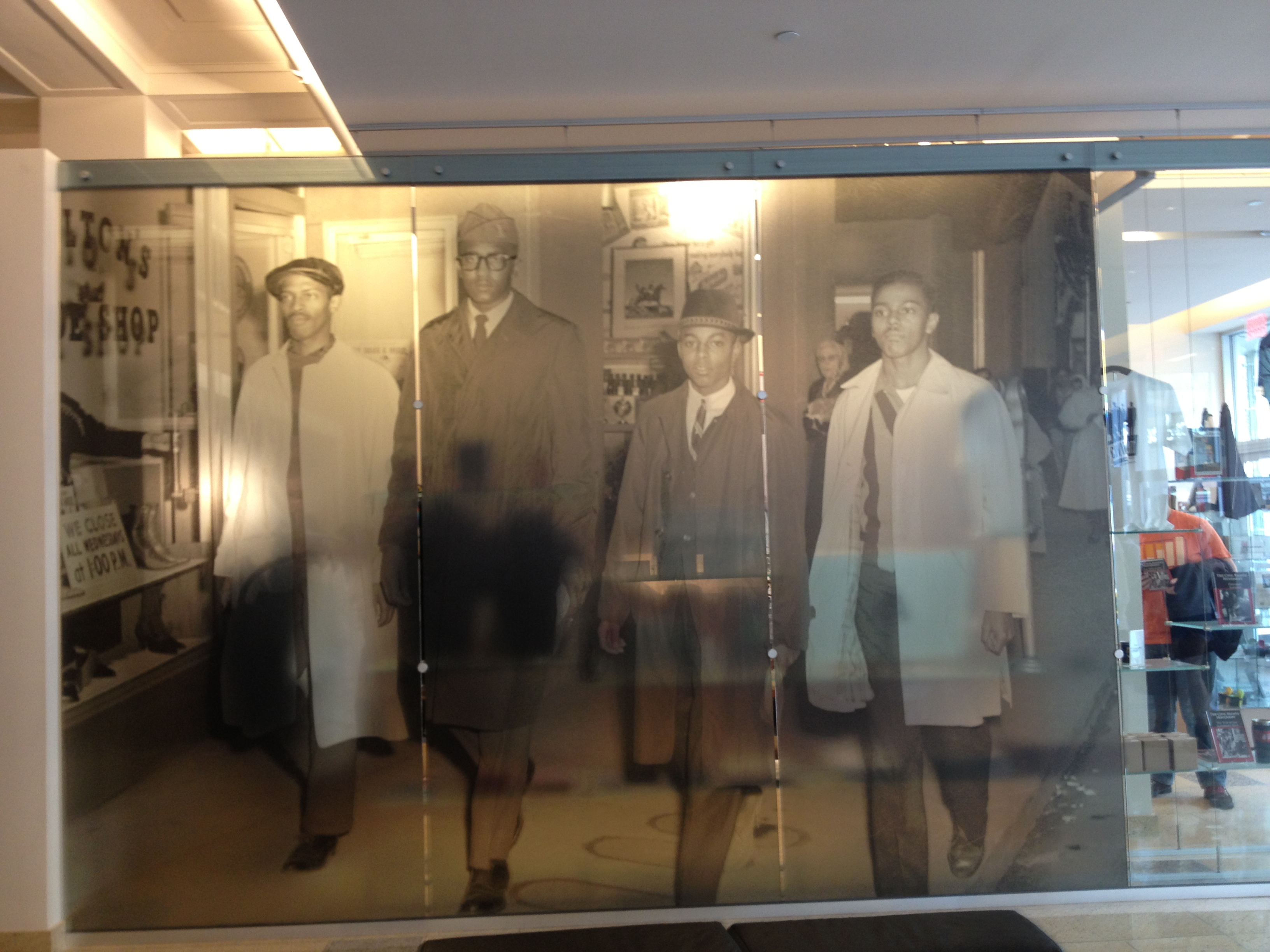
A sepia picture of four African-American men greeted me as I walked through the entrance of the ICRCM. The security guard watched me from behind his marble desk scratching his head as 30 or so Elon students and staff flocked in for a tour. Not many people seem to come to this place what looks to be another typical museum with historical photos and informational plaques. Our tour guide, Marcus Van Hagen, ushered us through the main lobby. He took us downstairs into a dark hallway called the “Hall of Shame.”

Four freshmen (Joseph McNeil, Franklin McCain, Ezell Blair, Jr. and David Richmond) stood up to segregation. (PHOTO BY MATT LEE)

Four first-year students (Joseph McNeil, Franklin McCain, Ezell Blair, Jr. and David Richmond) stood up to segregation.
(PHOTO BY MATT LEE)

Fluorescent pictures framed in shapes that looked like broken glass immediately surrounded me. Van Hagen hardly said anything; the pictures spoke for themselves. Every picture represented one of countless heinous acts committed against black people and their white supporters. Red lights signifying the bloodshed directed me past each gruesome photo. A speaker system overhead played chants from menacing Ku Klux Klan rallies and screams from Bull Connor’s unspeakable fire hosing of black children. The sights and sounds ended with a picture of Emmett Till, a boy whose face was so he could only be identified by a ring he had on his finger. The KKK had disfigured his face with barbed wire after he flirted with a white woman. This exhibit guided me through decades of African-American hate crimes. The “Hall of Shame” didn’t seem like an exhibit I would find at any other museum.

Van Hagen took us back upstairs into the main lobby. Next to the staircase that led us to the “Hall of Shame” were two doors. I walked through these doors to find a lunch counter, one that had been preserved from the time of the civil rights movement.

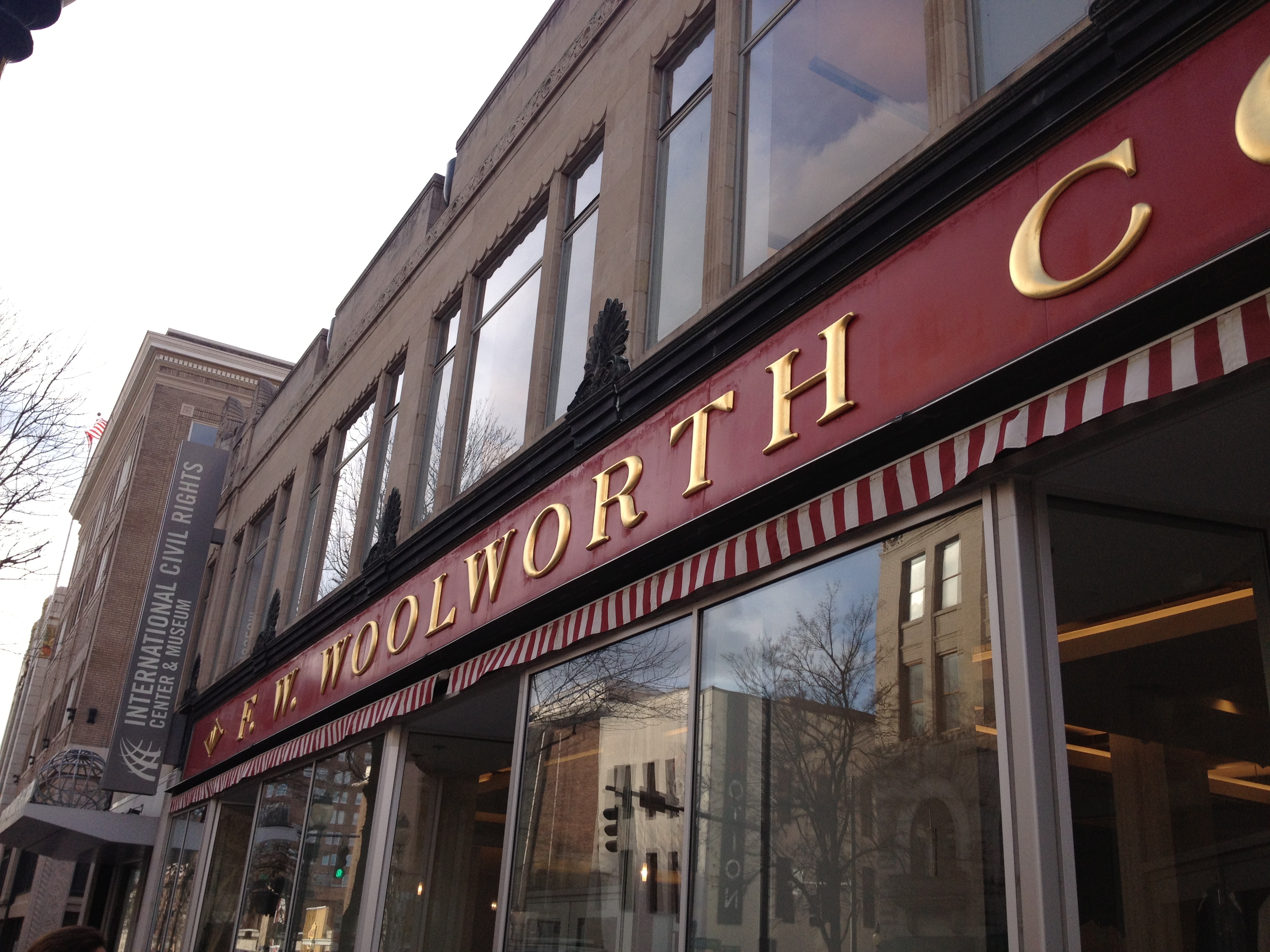
In the 1960s, F.W. Woolworth retail store was the main attraction on South Elm Street. But in 2010, the ICRCM took over the Woolworth building. The lunch counter, sitting in front of me, is the only original part of F.W. Woolworth still around besides the building. Menus offering 10-cent coffee and 65-cent turkey sandwiches and an antique cash register completed the scene. New seats and five TV screens were the only new additions. Behind the counter, I watched a film on the TV screens about a sit-in that occurred in this very spot about 50 years prior.

The ICRCM is located in downtown Greensboro.(PHOTO BY MATT LEE)

The ICRCM is located in downtown Greensboro.
(PHOTO BY MATT LEE)

Four first-year students from North Carolina A&T State University decided to stand up to segregation and sit at a “whites-only” lunch counter in the F.W. Woolworth retail store on Feb. 1, 1960. In the film, actors wore clothes from the 1960s and talked with southern accents, reacting how many citizens would after seeing four African-American men sit at a “whites-only” lunch counter. The ICRCM’s film and the 1960s environment come together to recreate what it would have been like to witness the first sit-in of the civil rights movement.

Outside the lunch counter, Van Hagen led us through another scene from the 1960s. The exhibit entitled “Stranglehold” provided another glimpse of segregated America. As I walked through the exhibit, a replica of the Greensboro Rail Depot “colored” entrance stood overhead. Van Hagen said the exhibit is designed to make visitors feel claustrophobic in order to represent the strict environment of the colored section of the train depot. Inside the exhibit, a barrier separates an authentic Coca-Cola machine into two parts, like it would have been in the 1960s. I looked at the soda machine from two sides. Coca-Cola on the side for white people is only 5 cents, but Coca-Cola on the side for colored people is 10 cents. According to Van Hagen, ice companies would only put ice in the white side of the soda machine forcing blacks to pay twice as much for a hot soda. This exhibit forced me to experience segregation and the “stranglehold” it had on African Americans in their struggle for equality.

The museum is located on 134 S. Elm St. in Greensboro and is open Tuesday through Sunday. Tickets are $10 for adults, $8 for students and seniors, $6 for children and free for children under the age of six.

###

For more information click here

City council: Tree ordinance to be updated after hearing recommendations

City council: Tree ordinance to be updated after hearing recommendations

By Matt Lee

Matt Lee

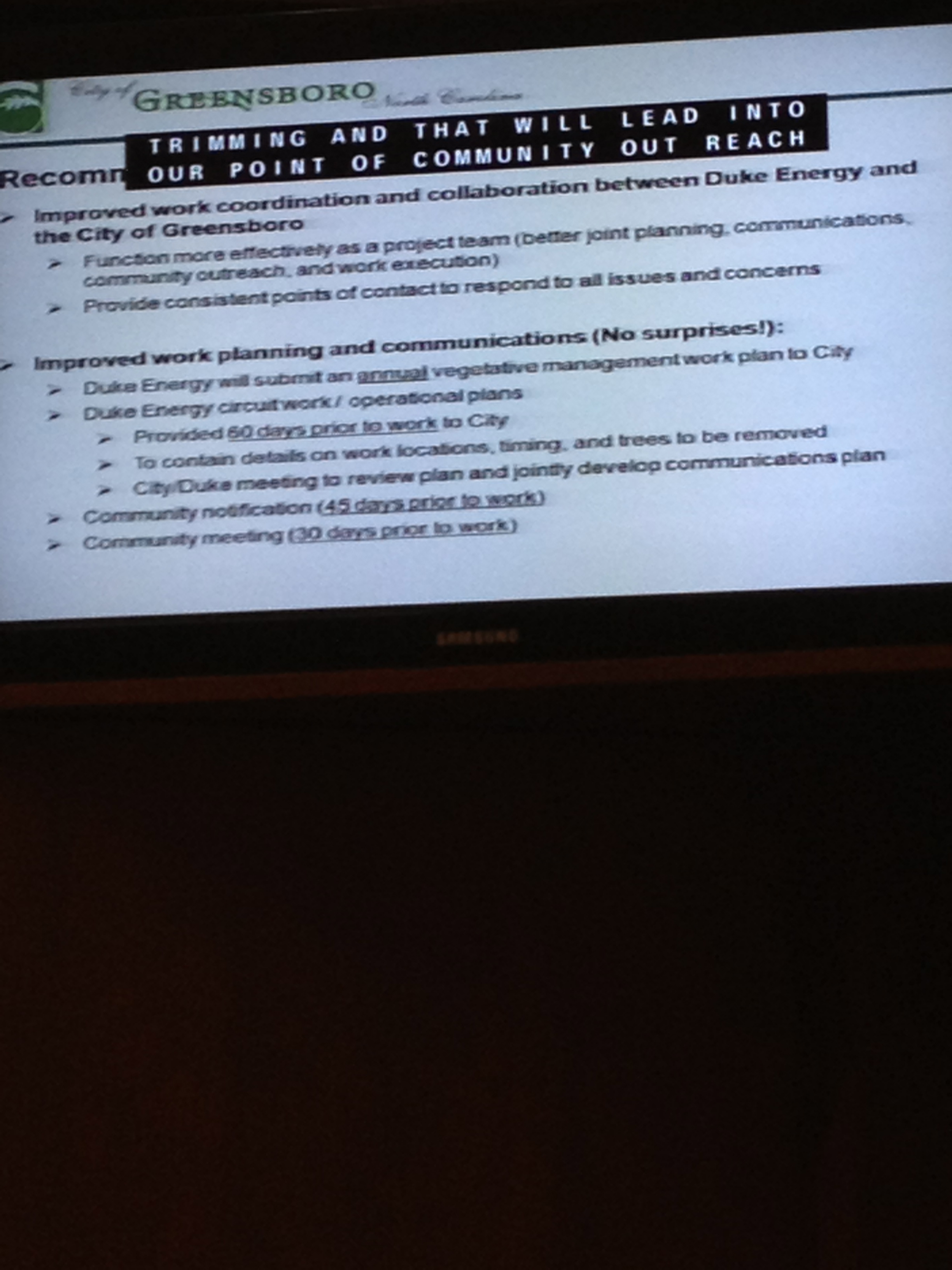
Some citizens watched the crowded city council meeting on TV screens.
(PHOTO BY MATT LEE)

GREENSBORO- The Greensboro City Council has sent its working group back to work on updating the city’s tree ordinance in order to protect trees from utility company pruning.

The request comes after Duke Energy cut down trees in several Greensboro residential neighborhoods in December leaving citizens outraged by the destruction and cleanup. Many of these same citizens showed up at Tuesday night’s crowded city council meeting hoping that the council would enact new legislation to protect the city’s trees.

After its December council meeting, city council members created a city-utility group to identify the issues in the tree dilemma and recommend solutions. The team collaborated with Duke Energy and identified inadequate communications and advance work notification as the core issues.

“We think there is some benefit and direct ability for us to do a better job as it relates to planning,” said Deputy City Manager Jim Westmoreland, who led the city-utility group.

The city-utility group recommended that Duke Energy provide advanced notice of which trees will be removed and to ask for permission before removing trees on private property.

Duke Energy’s District Manager Davis Montgomery said that the company plans on reestablishing trust with local residents.

“Tree removal is our option of last resort,” Montgomery said.

But residents like Drew Perry of Westerwood are worried that trees are still vulnerable to utility companies.

(more)

“This is not a problem of communication,” Perry said. “The problem is haphazard pruning of trees.”

Perry and other residents request a new ordinance with tighter line clearance standards for cutting down trees, one that insists utility companies prune not clear cut trees. Many residents also asked for utility companies to provide an honest and comprehensive appeal process.

Councilwoman T. Dianne Bellamy-Small sympathizes with residents who lost trees but also understands the importance of freeing power lines from trees to limit power outages.

“We must try to figure out how to coexist,” Bellamy-Small said. “I don’t ever want to see beautiful tree ripped apart and violated, but at the same time understand that when you’re cold and we do get an ice storm, it takes them several days to remove a tree if it fell on the power line.”

Mayor Pro Tem Yvonne Johnson is pleased with the progress the city is making.

“ [Citizens] you are going to get what you want,” Johnson said. “And Duke Energy we’re going to be fair in giving that.”

For now, Duke Energy will halt all tree pruning until a new ordinance is approved. The city-utility group’s plans for an updated tree ordinance will be presented during the February 26th city council work session.

###

For more information click here.

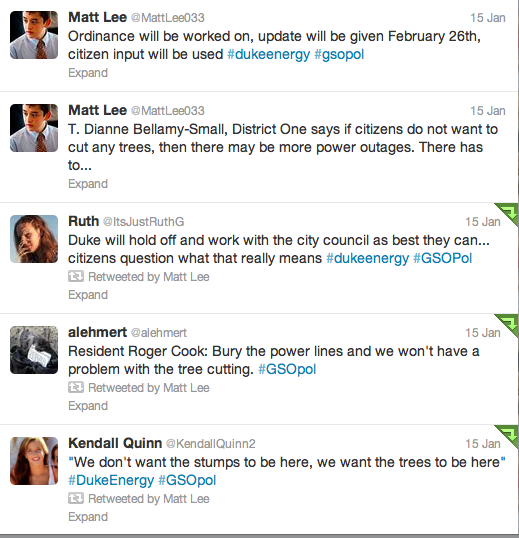
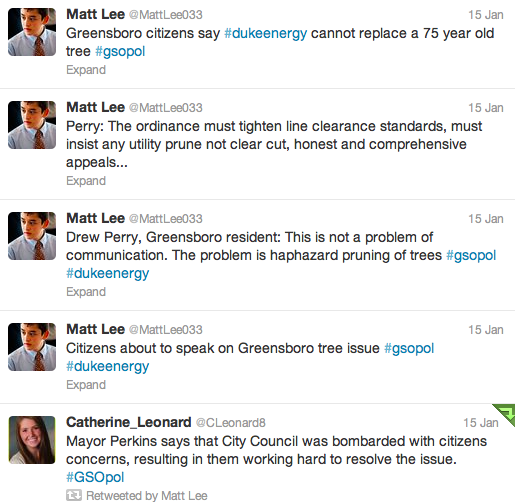
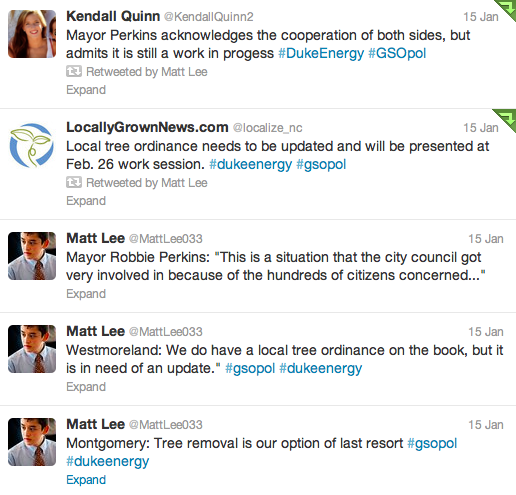
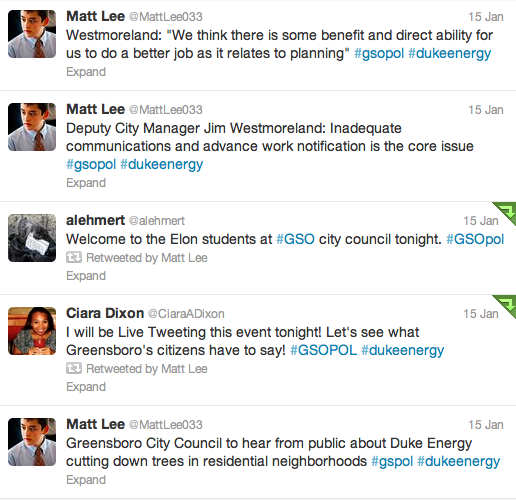
Liveblogging: Greensboro City Council Meeting Jan. 15

Matt Lee's Twitter  https://twitter.com/MattLee033

Greensboro City Council- Jan.15
https://twitter.com/MattLee033

Greensboro City Council Meeting- Jan. 15 https://twitter.com/MattLee033

Greensboro City Council Meeting- Jan. 15
https://twitter.com/MattLee033

Greensboro City Council Meeting- Jan. 15 https://twitter.com/MattLee033

Greensboro City Council Meeting- Jan. 15
https://twitter.com/MattLee033

Screen shot 2013-01-23 at 12.34.59 AM

Greensboro City Council Meeting- Jan. 15
https://twitter.com/MattLee033

Greensboro City Council Meeting- Jan. 15 https://twitter.com/MattLee033

Greensboro City Council Meeting- Jan. 15
https://twitter.com/MattLee033

Greensboro City Council Meeting- Jan. 15https://twitter.com/MattLee033

Greensboro City Council Meeting- Jan. 15
https://twitter.com/MattLee033

Greensboro City Council Meeting- Jan. 15https://twitter.com/MattLee033

Greensboro City Council Meeting- Jan. 15
https://twitter.com/MattLee033

News story: Restraining creative thinkers: a dull future

Restraining creative thinkers: a dull future

By Matt Lee

ELON- The future’s struggles are unknown, but America’s education system is continuing to repress creative thinkers, discouraging innovators from transforming the future, according to Sir Ken Robinson. The issue affects college campuses around the nation including Elon University, a school Robinson visited Monday morning.

“Creativity is as important now in education as literacy, and we should treat it as such,” Robinson said.

Robinson led the British government’s 1998 advisory committee on cultural education and was knighted in 2003 for his education reforms. Since then, he has made speeches urging educators to rethink the education system; one that cuts creative programs and denounces the arts. Intelligence is dynamic and creativity is an outlet for students to discover their talents, Robinson said.

One of the forums for expressing creativity at Elon University is through the performing arts, a department that has had significant budget cuts. Dr. Dean Gallery, chair of the Elon University Performing Arts Department, says their budget is cut about 3 percent each year. Reduced financial funding has stopped many students from pursuing a performing arts degree at Elon.

“We lose students to the school of the arts because [other arts schools] have much better funding,” assistant professor Dr. Bull Margin said. “I think education can restrict the creativity of young people.”

According to a 2012 National Center for Education Statistics report, the top bachelor’s degrees were concentrated in two fields: education and business.

(more)

“Every education system on earth has the same hierarchy of subjects: at the top are mathematics and languages, then the humanities, and the bottom are the arts,” Robinson said.

Robinson believes the increasing disregard for creative expression neglects students who thrive in a different setting. Acting majors like first-year student Tony Weaver often feel the pressure to leave the arts.

“The only reason I am allowed to be [in the acting program] is because I am double-majoring in communications,” Weaver said.

Weaver’s parents initially rejected his passion for acting. They later realized acting was more than just a hobby — it was something he wanted to do for the rest of his life. However, some students still struggle to choose a major that often garners lower salaries and less parental support.

“My parents support me 100 percent but they are also realistic in saying that I need to have something else so I won’t live that starving artist lifestyle,” Weaver said.

But not every artist lives a “starving artist lifestyle.” Robinson talked about Gillian Lynne, a girl who struggled to focus in school. Lynne was almost treated for ADD, but during the session she started dancing to the radio and the psychiatrist realized she just needed to be challenged in her own realm. Lynne was then enrolled into a dance school and became a distinguished choreographer famous for the musical “Cats.”

Robinson’s new book “Epiphany” became available at the Elon University Bookstore Monday and reinforces strategies needed to foster creativity in the American education system in order to prepare students for a successful career.

“We all have a vested interest in education because it takes us into this future that we cannot grasp,” Robinson said.

###

Click here to listen to Sir Ken Robinson’s speech on creativity and the education system.