Wrote a feature story on the International Civil Rights Center & Museum in Greensboro, N.C.
“The International Civil Rights
Center & Museum: A portal into the 1960s”
By Matt Lee
A tourist attraction in downtown Greensboro recreates the civil rights movements through sight, sound and touch.
The International Civil Rights Center & Museum (ICRCM) is not just a modern-day tourist attraction; it is a time capsule allowing visitors to transport themselves into the 1960s during the civil rights movement. Exhibits recreate sights, sounds and emotions from civil rights history in a location where four first-year students sat at a lunch counter and changed the tide of the civil rights movement.
A sepia picture of four African-American men greeted me as I walked through the entrance of the ICRCM. The security guard watched me from behind his marble desk scratching his head as 30 or so Elon students and staff flocked in for a tour. Not many people seem to come to this place what looks to be another typical museum with historical photos and informational plaques. Our tour guide, Marcus Van Hagen, ushered us through the main lobby. He took us downstairs into a dark hallway called the “Hall of Shame.”
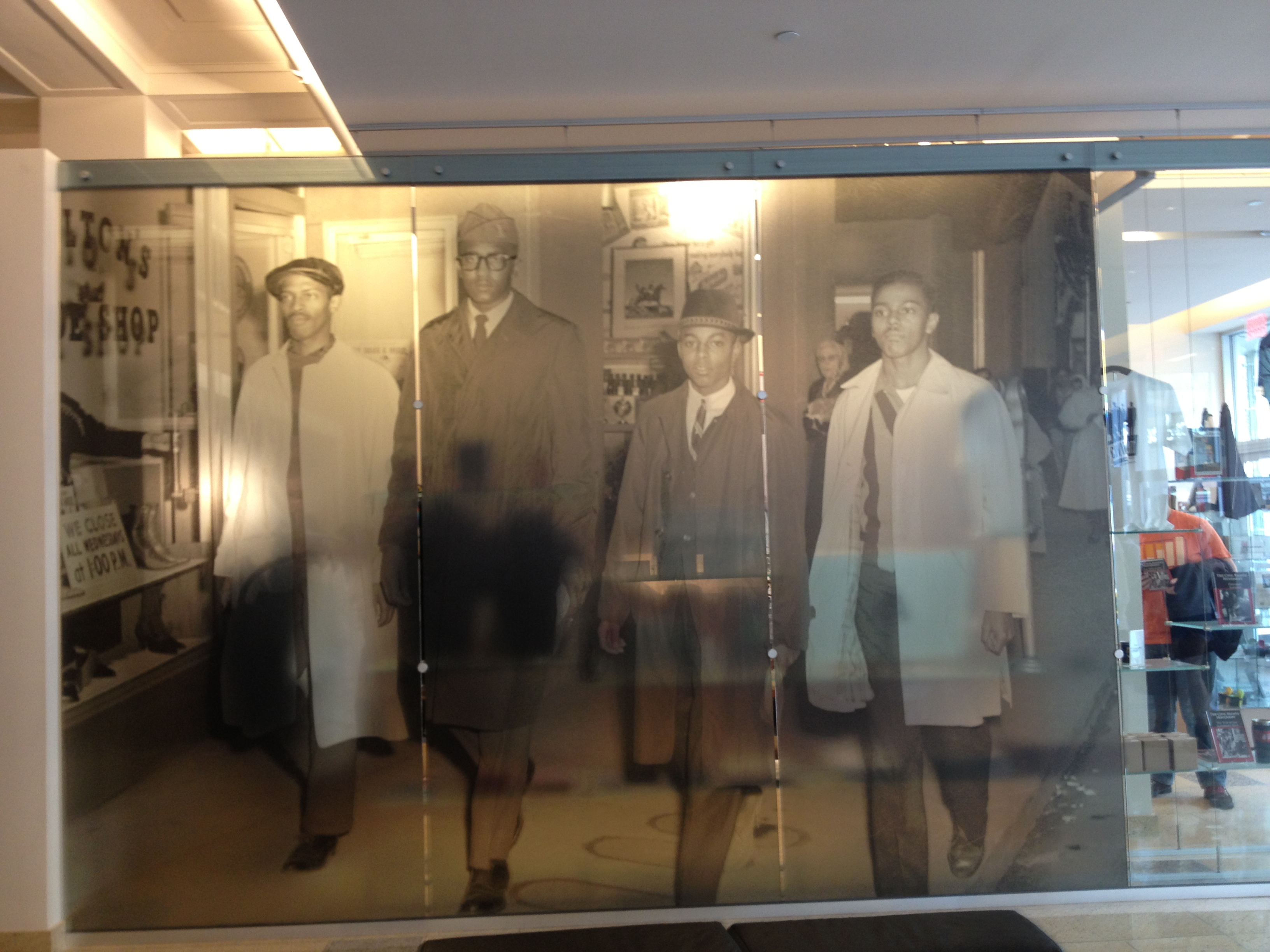
Four first-year students (Joseph McNeil, Franklin McCain, Ezell Blair, Jr. and David Richmond) stood up to segregation.
(PHOTO BY MATT LEE)
Fluorescent pictures framed in shapes that looked like broken glass immediately surrounded me. Van Hagen hardly said anything; the pictures spoke for themselves. Every picture represented one of countless heinous acts committed against black people and their white supporters. Red lights signifying the bloodshed directed me past each gruesome photo. A speaker system overhead played chants from menacing Ku Klux Klan rallies and screams from Bull Connor’s unspeakable fire hosing of black children. The sights and sounds ended with a picture of Emmett Till, a boy whose face was so he could only be identified by a ring he had on his finger. The KKK had disfigured his face with barbed wire after he flirted with a white woman. This exhibit guided me through decades of African-American hate crimes. The “Hall of Shame” didn’t seem like an exhibit I would find at any other museum.
Van Hagen took us back upstairs into the main lobby. Next to the staircase that led us to the “Hall of Shame” were two doors. I walked through these doors to find a lunch counter, one that had been preserved from the time of the civil rights movement.
In the 1960s, F.W. Woolworth retail store was the main attraction on South Elm Street. But in 2010, the ICRCM took over the Woolworth building. The lunch counter, sitting in front of me, is the only original part of F.W. Woolworth still around besides the building. Menus offering 10-cent coffee and 65-cent turkey sandwiches and an antique cash register completed the scene. New seats and five TV screens were the only new additions. Behind the counter, I watched a film on the TV screens about a sit-in that occurred in this very spot about 50 years prior.
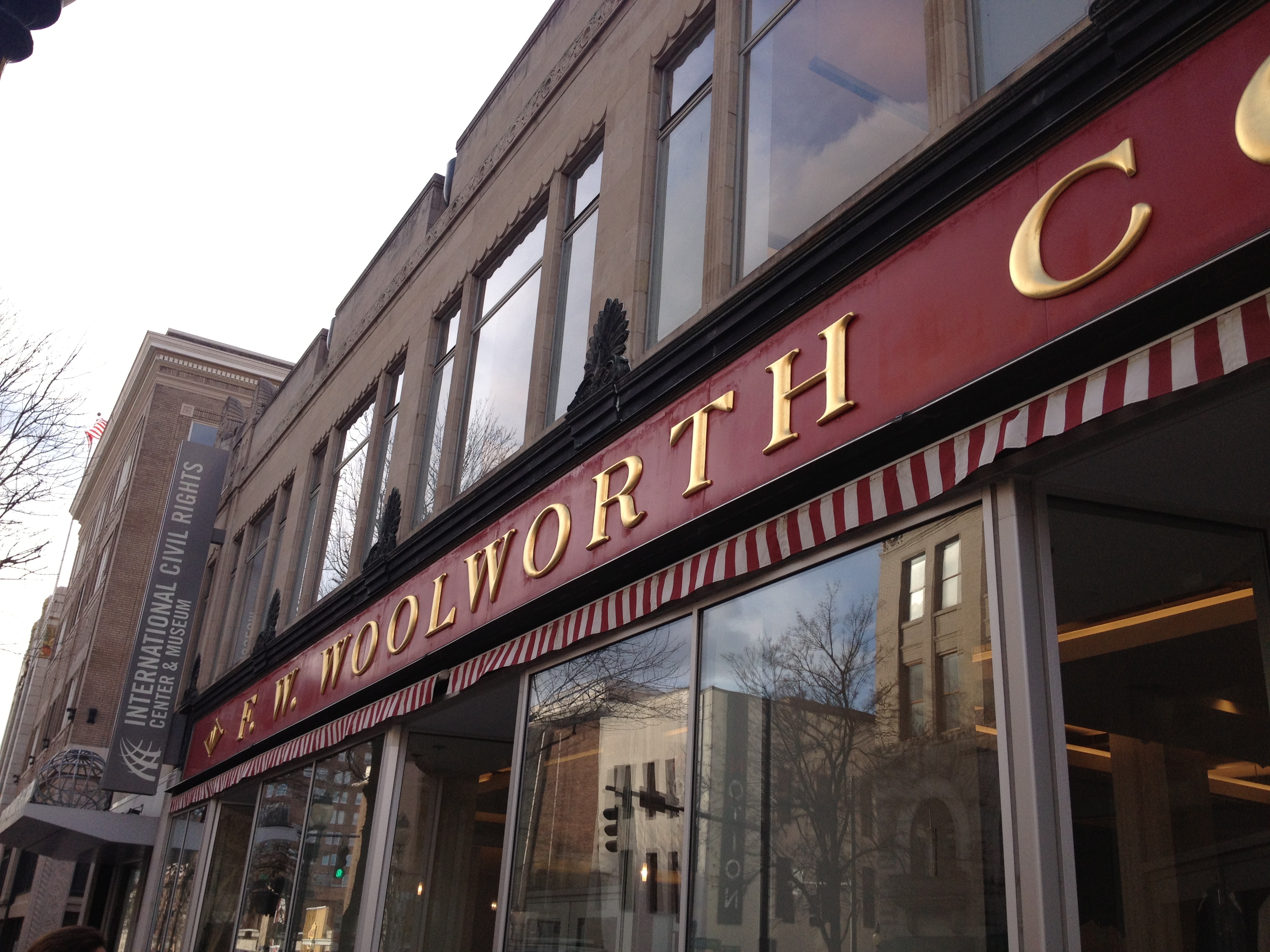
The ICRCM is located in downtown Greensboro.
(PHOTO BY MATT LEE)
Four first-year students from North Carolina A&T State University decided to stand up to segregation and sit at a “whites-only” lunch counter in the F.W. Woolworth retail store on Feb. 1, 1960. In the film, actors wore clothes from the 1960s and talked with southern accents, reacting how many citizens would after seeing four African-American men sit at a “whites-only” lunch counter. The ICRCM’s film and the 1960s environment come together to recreate what it would have been like to witness the first sit-in of the civil rights movement.
Outside the lunch counter, Van Hagen led us through another scene from the 1960s. The exhibit entitled “Stranglehold” provided another glimpse of segregated America. As I walked through the exhibit, a replica of the Greensboro Rail Depot “colored” entrance stood overhead. Van Hagen said the exhibit is designed to make visitors feel claustrophobic in order to represent the strict environment of the colored section of the train depot. Inside the exhibit, a barrier separates an authentic Coca-Cola machine into two parts, like it would have been in the 1960s. I looked at the soda machine from two sides. Coca-Cola on the side for white people is only 5 cents, but Coca-Cola on the side for colored people is 10 cents. According to Van Hagen, ice companies would only put ice in the white side of the soda machine forcing blacks to pay twice as much for a hot soda. This exhibit forced me to experience segregation and the “stranglehold” it had on African Americans in their struggle for equality.
The museum is located on 134 S. Elm St. in Greensboro and is open Tuesday through Sunday. Tickets are $10 for adults, $8 for students and seniors, $6 for children and free for children under the age of six.
###
For more information click here
Wrote a feature article on creative innovation
“Restraining creative thinkers: a dull future”
By Matt Lee
ELON- The future’s struggles are unknown, but America’s education system is continuing to repress creative thinkers, discouraging innovators from transforming the future, according to Sir Ken Robinson. The issue affects college campuses around the nation including Elon University, a school Robinson visited Monday morning.
“Creativity is as important now in education as literacy, and we should treat it as such,” Robinson said.
Robinson led the British government’s 1998 advisory committee on cultural education and was knighted in 2003 for his education reforms. Since then, he has made speeches urging educators to rethink the education system; one that cuts creative programs and denounces the arts. Intelligence is dynamic and creativity is an outlet for students to discover their talents, Robinson said.
One of the forums for expressing creativity at Elon University is through the performing arts, a department that has had significant budget cuts. Dr. Dean Gallery, chair of the Elon University Performing Arts Department, says their budget is cut about 3 percent each year. Reduced financial funding has stopped many students from pursuing a performing arts degree at Elon.
“We lose students to the school of the arts because [other arts schools] have much better funding,” assistant professor Dr. Bull Margin said. “I think education can restrict the creativity of young people.”
According to a 2012 National Center for Education Statistics report, the top bachelor’s degrees were concentrated in two fields: education and business.
“Every education system on earth has the same hierarchy of subjects: at the top are mathematics and languages, then the humanities, and the bottom are the arts,” Robinson said.
Robinson believes the increasing disregard for creative expression neglects students who thrive in a different setting. Acting majors like first-year student Tony Weaver often feel the pressure to leave the arts.
“The only reason I am allowed to be [in the acting program] is because I am double-majoring in communications,” Weaver said.
Weaver’s parents initially rejected his passion for acting. They later realized acting was more than just a hobby — it was something he wanted to do for the rest of his life. However, some students still struggle to choose a major that often garners lower salaries and less parental support.
“My parents support me 100 percent but they are also realistic in saying that I need to have something else so I won’t live that starving artist lifestyle,” Weaver said.
But not every artist lives a “starving artist lifestyle.” Robinson talked about Gillian Lynne, a girl who struggled to focus in school. Lynne was almost treated for ADD, but during the session she started dancing to the radio and the psychiatrist realized she just needed to be challenged in her own realm. Lynne was then enrolled into a dance school and became a distinguished choreographer famous for the musical “Cats.”
Robinson’s new book “Epiphany” became available at the Elon University Bookstore Monday and reinforces strategies needed to foster creativity in the American education system in order to prepare students for a successful career.
“We all have a vested interest in education because it takes us into this future that we cannot grasp,” Robinson said.
###
Click here to listen to Sir Ken Robinson’s speech on creativity and the education system.
 Matt Lee